
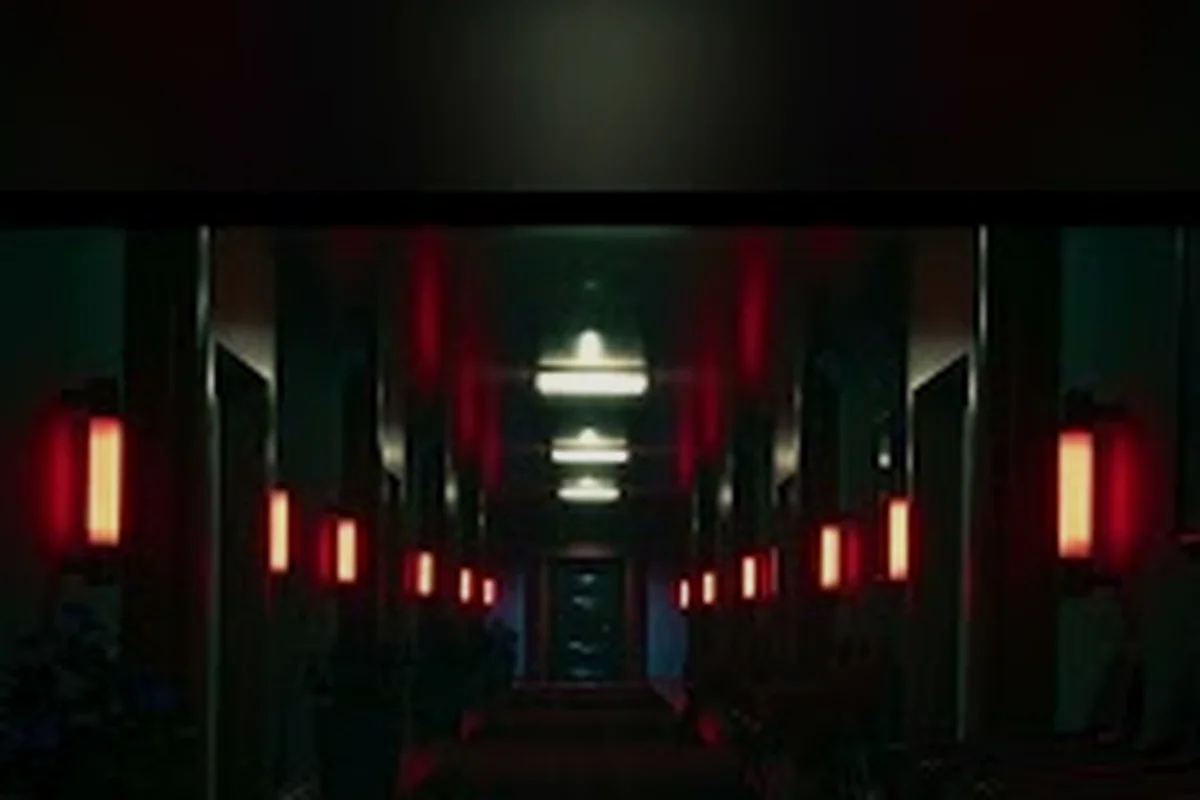
The aspis red world meaning hinges on whether this crimson realm is another physical layer, a failed experiment, or evidence that the entire system is artificial. Official clues connect the Red World to ancient structures, shifting realities, and the PEP-01, but they do not settle the answer outright.
ASPIS Red World Meaning and Official Evidence
The most responsible reading of the aspis red world meaning is that the Red World is an anomalous reality within the larger ASPIS experiment. It looks like a stylized, hostile environment rather than a normal district of the alternate Soviet setting, which suggests that it belongs to a different layer of reality. The visual change matters because the official site presents the Red World and a red corridor as gallery subjects, while the same site describes ASPIS as a passage into spaces whose physical rules stop matching our own.
That official distinction is crucial. The site does not say the Red World is a simulation. Instead, it says ASPIS was not a simulation but a bridge, which makes a simulated-environment interpretation possible without treating it as confirmed fact. The official Dream Wire Games gallery therefore supports the layered-reality reading more directly than it supports a straightforward simulation claim.
What the Red World communicates
The red palette does more than establish danger. It separates the space visually from the Soviet research facilities, the Institute of Cybernetics, and the island associated with Lukomorye. Because the gallery captions do not provide a full explanation, the most defensible clues come from the combination of color, architecture, and the game’s use of astral windows.
| Observed clue | What it can indicate | Confidence |
|---|---|---|
| Red World gallery caption | A named environment distinct from ordinary locations | High |
| Red corridor imagery | Passage or transition between layers | Medium |
| Astral windows | Communication or travel between realities | High |
| Ancient-looking structures | Origins that may predate the experiment | Medium |
| No official simulation explanation | The question remains deliberately unresolved | High |
| Official denial of a simulated ASPIS | The system may be a bridge instead | High |
This makes the red environment important for interpretation. It could be a separate reality reached through the system, a corrupted version of the original environment, or a visual representation of a dangerous state. Community interpretations often treat the Red World as a hidden or unstable layer, but those readings remain theories rather than confirmed lore.
Reading Not a Simulation Without Overreach
The phrase “not a simulation” does not automatically prove that everything inside ASPIS is real. A bridge can connect to simulated spaces, artificial memories, or constructed environments. The distinction becomes important when examining aspis real or simulated interpretations: the official site rejects one simple description of the whole system while still leaving the status of individual layers open to interpretation.
The experiment also operates on a different temporal basis. Official material says time inside the system moves far faster than outside, and a planned experiment of days becomes more than a year for the six volunteers. That makes the red world potentially a constructed chronology rather than a straightforward location on Earth. It also explains why visual and architectural clues matter: a layer assembled through a predictive system may borrow from history without belonging to one recognizable historical period.
ASPIS Ancient Structures and Layered Environments
The question of aspis ancient structures points toward the game’s most consequential ambiguity. If ASPIS only assembled a convincing 1987 Soviet environment, ruins would represent the system’s historical reconstruction. If the Red World contains structures that predate the experiment or combine incompatible architectural styles, it may represent an independent reality, a recovered memory, or a time layer produced by the system.
Official material identifies ancient structures as a recurring visual concept, but it does not publish their builders, age, or function. Consequently, no map of the Red World should be treated as a literal archaeological record. The structures are better read as evidence of layered chronology: they show that whatever Andrey and the volunteers are crossing may have existed before, existed elsewhere, or been reconstructed from incomplete historical data.
Comparing possible readings of the ruins
| Interpretation | How the ruins fit | What weakens it |
|---|---|---|
| Historical simulation | ASPIS reconstructed old locations from source material | The architecture appears too alien or stylistically combined |
| Separate reality | The Red World has its own history | Official material gives no builder or chronology |
| Memory repository | Structures represent lost or encoded experiences | No official document confirms this function |
| Time displacement | Ruins preserve a different era | The game does not openly label the Red World as a time-travel zone |
| Corrupted reconstruction | The system blended incompatible places and eras | This remains an interpretive explanation |
This ambiguity is central to aspis layers explained. The game’s own concept of realities connected by astral windows gives the player a vocabulary for reading the environment, but it does not guarantee that every visual contradiction has one clean explanation. A layered system can contain stable layers, unstable transitions, and zones where information from several realities overlap.
The architecture as a layer indicator
Architecture can reveal whether a space belongs to a coherent layer. The red corridor, for example, reads as transitional because it links environments rather than functioning like a normal inhabited district. Ancient structures, by contrast, can signal that the current layer has inherited a pre-existing history. Repeating geometric forms and impossible spatial relationships then suggest overlapping architectural records, not merely abandoned Soviet buildings.
For readers tracing the wider project, the broader ASPIS project history provides context for the Institute of Cybernetics and the experiment’s Soviet setting. That background helps distinguish the Red World from ordinary alternate history: the red realm appears connected to the experiment’s deeper purpose, not simply to Soviet history itself.
ASPIS Layers Explained Through the PEP-01
The PEP-01 is the clearest mechanical link between the red environment and layered reality. Official material says the device interacts with Energy X and opens astral windows between layers. The device therefore gives the abstract idea of multiple realities a physical connection to Andrey’s actions. Without it, the Red World could be read as a symbolic nightmare; with it, the region is plausibly one destination in a larger navigational system.
What the PEP-01 proves and does not prove
| Device clue | Supported conclusion | Unresolved issue |
|---|---|---|
| It opens astral windows | Travel between realities is possible | It does not reveal who built the layers |
| It interacts with Energy X | The system has an active energy component | Energy X’s precise nature remains unclear |
| The Red World is visually distinct | It likely differs from ordinary reality | A visual difference does not prove simulation |
| Time differs inside ASPIS | The system distorts chronology | It does not prove the environment was fabricated |
| Astral windows can connect destinations | Layer boundaries are traversable | The Red World may not be the final layer |
The more precise question is what aspis simulation theory actually claims. A strong version says ASPIS is a computer-generated historical model. A moderate version says the volunteers entered a system capable of producing convincing environments from incomplete information. A weak version says the Red World is only a rendered-looking zone. The official material supports the existence of a predictive system and strange laws, but it does not give players technical details that would identify the underlying technology.
The role of the Cat and the Director
The Cat helps Andrey interpret the rules of the place, while the Director leads him deeper in search of answers. Their roles create a useful interpretive model. The Cat appears concerned with local behavior, boundaries, and rules; the Director appears concerned with outcomes and the experiment’s purpose. That contrast can be read as a dispute between understanding a reality from within it and manipulating it from an external authority.
This also connects the Red World to the wider OGAS lore and timeline, where the system’s origin and purpose remain open to interpretation. If the Cat understands rules that even the Director does not explain, the Red World may be more than a test environment. It may be a domain whose operating logic differs from the Institute’s understanding.
ASPIS Real or Simulated: Four Interpretations
The aspis real or simulated question cannot be answered with a single label because the official description uses several overlapping terms: prediction, historical events, layers of reality, a bridge, and accelerated time. Each term points in a different direction, and the Red World sits at the center of that tension.
A real reading treats the red environment as another place connected to the experiment. The volunteers are physically present, and the system is the bridge rather than the destination. The accelerated chronology and strange laws remain major anomalies, but they do not require every landscape to be generated by a computer.
A simulated reading treats ASPIS as an artificial predictive environment. Red architecture, impossible space, and reconstructed history would fit a system assembling plausible or deliberately fragmented settings. The weakness is the site’s explicit statement that ASPIS was not a simulation. A hybrid remains possible: ASPIS itself may be real, while some connected layers are artificial or reconstructed.
Evidence supporting each model
| Model | Supporting evidence | Evidence against a definitive reading |
|---|---|---|
| Real bridge | Official description calls ASPIS a bridge | Laws and time differ from ordinary reality |
| Full simulation | Predicts history, manipulates environments, accelerates time | Official material explicitly rejects this description |
| Layered reality | Astral windows connect different realms | The Red World’s exact status is unnamed |
| Artificial reconstruction | Ancient styles can be blended from stored records | No database or generation process is documented |
| Memory-linked space | The Cat teaches rules and objects carry traces of people | Official documents do not define a memory mechanism |
A hybrid construction offers the best compromise. ASPIS could be a real predictive bridge that uses simulations as interfaces, gateways, or habitats. Under that model, the Red World might be an artificial layer embedded inside a genuinely connected multiverse. The game’s two endings and one final choice make such a split meaningful, although the official pages do not reveal which ending confirms which interpretation.
The uncertainty is intentional rather than careless. The story begins with an engineer named Andrey, his deceased wife Anna, his daughter Liza, six volunteers, and an Institute experiment. The personal stakes make the system feel real, while the layered spaces make ordinary reality impossible to assume. The deeper story explanation can help readers track how Andrey’s family and the experiment connect to the final decision.
ASPIS What Really Happened: Reading the Clues
The search for aspis what really happened must begin with one documented fact: one year after the experiment begins, none of the six volunteers has awakened. Time inside ASPIS has advanced by more than a year, even though the experiment was expected to last only days. Whatever the Red World is, it is not a harmless recreation of a short test.
The achievement list provides another important clue. An achievement refers to re-entering the system, finding a drawing through a portal, hearing a freed prisoner at the edge of the island, and completing endings named “Let Go” and “World on Fire.” These objects imply that the system retains consequences, people, and choices. That is more complex than a passive historical playback.
A likely sequence of events
| Stage | Evidence | Interpretation |
|---|---|---|
| Experiment begins | Six volunteers enter ASPIS | The Institute expects a limited test |
| Time diverges | Internal time advances far beyond outside time | The environment follows different temporal rules |
| Layers are accessed | The PEP-01 opens astral windows | The system connects to or constructs other realities |
| Red World appears | It is presented as a distinct gallery environment | The group enters an anomalous or corrupted domain |
| Reality becomes debatable | The Cat teaches local rules while the Director seeks answers | Knowledge and control are separated |
| Final choice occurs | One choice produces two endings | The outcome may determine connection, release, or destruction |
This sequence remains an evidence-based reconstruction, not a confirmed chapter list. Official material publishes no episode names, number, or detailed chronological breakdown. The key pattern is still clear: the experiment becomes larger than its participants expected, and the Red World may mark the point where predictable history gives way to uncontrolled possibility.
Why the two endings matter
A final choice leading to two outcomes supports the idea that the core mystery concerns agency rather than mere discovery. If ASPIS were only a simulation, the meaningful choice would be whether to remain inside or escape. If it is a bridge to real layers, the choice could instead determine whether those layers remain connected, collapse, or become inaccessible. Both readings are valid because official material does not disclose the outcome.
The alternate-history setting adds another layer. The developer built locations from reference images of Soviet-era research sites, industrial plants and storage buildings, so historical accuracy provides a stable surface against which the red anomalies become more disturbing. The more realistic the Institute, the more the Red World can feel like a failed reconstruction or a reality with its own history.
Reading the Red World Without Treating Theories as Facts
A careful interpretation should separate three layers of confidence: what the game states, what the environment suggests, and what community readers infer. This prevents a compelling theory from becoming mistaken for confirmed lore.
A practical evidence checklist
When evaluating any proposed explanation, compare the claim with the available evidence:
-
Does the official site or store page directly support it?
-
Does the claim explain the red corridor and astral windows?
-
Does it account for accelerated time and the volunteers’ failure to awaken?
-
Is it consistent with both the real-bridge wording and the layered environments?
-
Is the claim based on a visible clue or only on thematic association?
| Claim | Evidence strength | Best label |
|---|---|---|
| The Red World is a distinct layer | Strong | Supported interpretation |
| The Red World is damaged or unstable | Moderate | Visual inference |
| ASPIS is entirely simulated | Weak to moderate | Fan theory, directly disputed by official wording |
| Ancient structures predate the experiment | Moderate | Unresolved clue |
| The system rebuilds history from records | Moderate | Plausible theory |
| The Red World contains the final answer | Suggestive | Ending-related theory |
Players who want a broader catalog of the documents and entities surrounding the experiment can use the ASPIS documents and dimensions overview. Keeping official statements, environmental clues, and speculation in separate categories makes the Red World easier to interpret without stripping away the game’s deliberate ambiguity.
The best working conclusion is that the Red World is a layered anomaly within the ASPIS system, probably created or shaped by the same process that connects realities. It may be artificial without making the entire experiment a simulation. The red architecture and ancient structures suggest displaced history, while the accelerated time and inaccessible exit suggest consequences the Institute never controlled. That reading honors the official material while leaving room for the competing idea that the system created its own worlds.
Frequently Asked Questions
What does the Red World represent in ASPIS?
The Red World most strongly represents a separate reality or anomalous layer reached through ASPIS. Its red visual design, ancient-looking structures, and connection to astral windows distinguish it from ordinary Soviet locations. The official material supports the layered reading, but it does not explain whether the realm is physical, reconstructed, or simulated.
Is ASPIS a computer simulation according to the developers?
No, the official site explicitly describes ASPIS as a bridge rather than a simulation. Nevertheless, individual layers could still be artificial, reconstructed, or governed by engineered rules. This distinction makes the Red World ambiguous without requiring the entire experiment to be fictional.
What are the ancient structures in the Red World?
Their age, builders, and purpose remain unexplained in official material. They may preserve a pre-existing reality, represent a period displaced by accelerated time, or combine historical sources assembled by ASPIS. Their strongest confirmed function is as a clue that the Red World has a history beyond the Institute’s immediate experiment.
Do the astral windows connect the Red World to other realities?
That is their documented general function. The PEP-01 opens windows between layers of reality, and the Red World is presented as a distinct environment within the larger system. The windows support a layered interpretation, although the official material does not provide a complete list of destinations or explain how each layer was formed.
Which explanation fits ASPIS what really happened best?
The strongest reconstruction is that an expected short experiment accelerated dramatically, exposed the volunteers to multiple realities, and led them into the Red World. The system may have become unpredictable once its participants encountered history it could not fully control. This remains an interpretation because official pages do not disclose the experiment’s mechanism, complete chronology, or ending outcomes.