
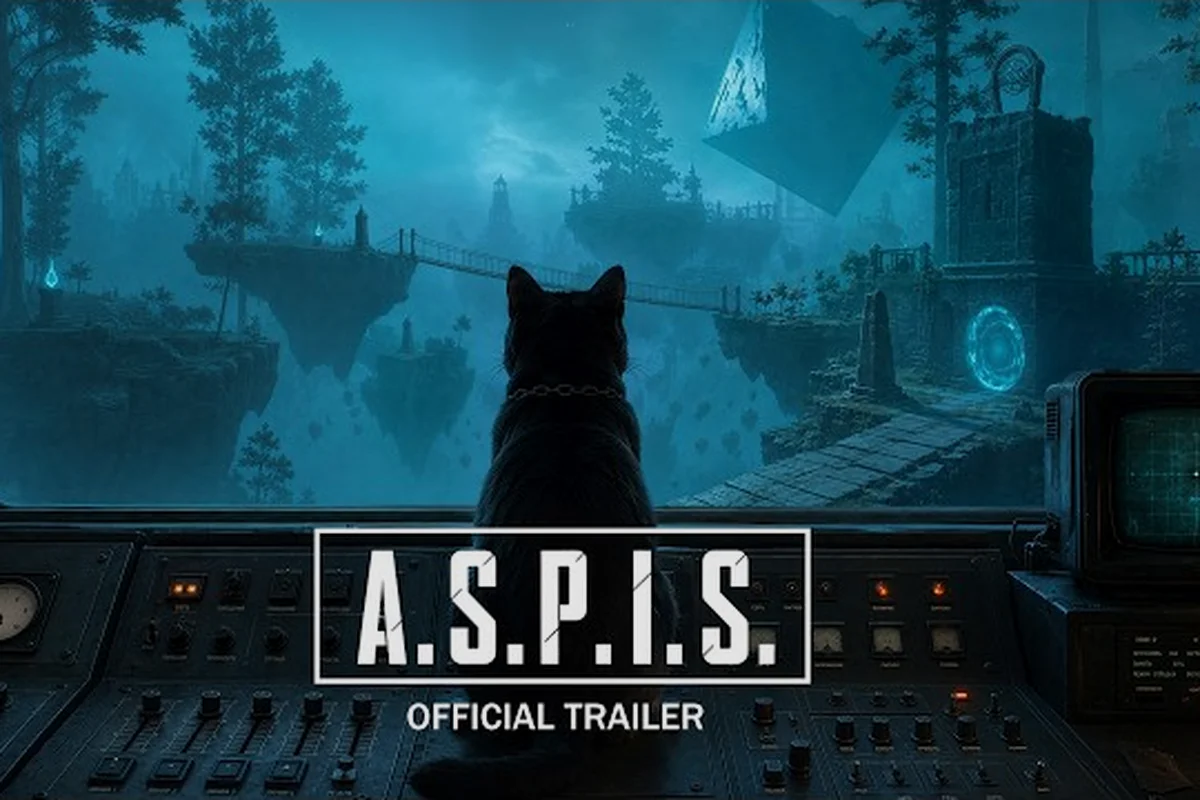
ASPIS story explained through Andrey’s desperate family mission, the Institute of Cybernetics, and OGAS’s unstable experiment in 1987. The key is separating the game’s documented premise from the darker possibilities surrounding its red world, lost time, and two endings.
The ASPIS Story and OGAS at a Glance
ASPIS places Andrey inside a reimagined Soviet Union in 1987, where an experiment connected to the Institute of Cybernetics appears to have failed. He is not simply a soldier or researcher: he is an engineer whose deceased wife, Anna, and daughter, Liza give his actions a deeply personal purpose. The official premise connects six volunteers, OGAS terminals, the PEP-01 device, Energy X, and windows into other layers of reality.
The central mystery is why the experiment did not end when planned. Although its participants were expected to return after days, well over a year elapses inside the system, and none of the six volunteers wakes. Time itself behaves unpredictably, while the Director offers Andrey answers and a mysterious Cat helps him understand the rules governing this place.
| Story element | What is officially established | What remains uncertain |
|---|---|---|
| ASPIS | Autonomous System for Predicting Historical Events | Why the system connects to reality-altering locations |
| OGAS | Connected to the Institute of Cybernetics and its experiment | Its exact mechanism and original purpose |
| Andrey | Engineer, husband of Anna, father of Liza | The full reason his family was selected |
| Six volunteers | Participants who have not awakened after more than a year | Where each volunteer is and whether rescue remains possible |
| Red world | A strange place entered through OGAS-related systems | Whether it is another world, a constructed space, or something stranger |
| Final choice | One decision leads to two endings | Which outcome represents the intended or “true” result |
That distinction is essential because the game presents a strong central story without fully exposing every causal link. The official ASPIS website states that ASPIS was not a simulation, yet it does not disclose how the experiment alters reality. This makes the “aspis lore explained” discussion more than a simple chronology: it is an exercise in reading the system’s evidence without treating speculation as confirmed fact.
Andrey, Anna, and Liza Drive the Emotional Story
Andrey’s identity gives the experiment a human center. The official store page identifies him as an engineer, Anna as his deceased wife, and Liza as his daughter. Even when the plot shifts toward the Institute of Cybernetics and the strange physics of OGAS, the family story remains the strongest reason for Andrey to keep moving. His decisions are therefore not abstract choices about a machine; they are actions shaped by grief, responsibility, and hope.
Anna’s death is especially important because it creates a question the player can evaluate emotionally: is Andrey pursuing a technical solution, a possible reunion, or evidence that his loved ones never disappeared in the first place? Liza adds a different emotional pressure. She represents what Andrey wants to protect, while her exact relationship to the experiment remains part of the unresolved story.
The family triangle in context
| Character | Known role | Narrative function |
|---|---|---|
| Andrey | Engineer connected to the experiment | Protagonist, investigator, and decision-maker |
| Anna | Andrey’s deceased wife | Establishes grief and creates the emotional stake |
| Liza | Andrey’s daughter | Connects Andrey’s mission to care and preservation |
| The Director | A figure who guides Andrey deeper | Promise of knowledge mixed with possible manipulation |
| The Cat | A being who helps Andrey read the rules | Interpreter of the unfamiliar environment |
The family is also why the story can remain grounded even when the setting becomes surreal. Official material calls the world an alternate-history USSR, and the developer built locations from reference images of Soviet-era research sites, industrial plants and storage buildings. This production detail supports the historical texture without establishing that every part of ASPIS is authentic Soviet history.
Anna and Liza are the story’s emotional anchor. Their presence turns OGAS from a cold experiment into a problem about loss, connection, and what a person is willing to risk for family. That also explains why the later decision carries more tension than an ordinary mission choice: Andrey is not choosing only which route to take, but which interpretation of his loss he can accept.
The Institute of Cybernetics and OGAS System
The “aspis system explained” part of the story begins with a broad contradiction. OGAS appears to be a predictive system linked to a major Soviet cybernetics institution, yet it leads to locations governed by unfamiliar laws. The Institute of Cybernetics therefore functions as the institutional bridge between recognizable Soviet science and the impossible red environment encountered through OGAS terminals.
ASPIS expands to Autonomous System for Predicting Historical Events, which suggests that the system is designed to model or anticipate history. However, the official premise never confirms that every event inside the game is a prediction. It instead describes ASPIS as a passage into spaces whose physical rules stop matching our own. As a result, the name raises an interpretive possibility rather than supplying a mechanical answer.
Official facts versus likely implications
| Official fact | Careful interpretation |
|---|---|
| ASPIS predicts historical events by name | The system may deal with recorded or possible history, but the game has not explained how |
| OGAS is tied to the Institute of Cybernetics | The institute may have supplied technical knowledge, personnel, or access |
| Time moves much faster inside the system | Duration inside the experiment differs greatly from duration outside it |
| The PEP-01 interacts with Energy X | The device serves as a link to energies or spaces beyond ordinary Soviet technology |
| Astral windows open between layers of reality | The environment contains multiple realities or perceptual layers |
| ASPIS is described as a bridge, not a simulation | The experienced space should not automatically be treated as virtual |
A further layer of confusion comes from Energy X and the astral windows. The PEP-01 appears to interact with this energy and use it to open passages between realities. The game does not provide a scientific model for the process, so descriptions of “energy” should not be treated like a conventional fuel source. It functions as a narrative and technological bridge: it permits movement, access, and contact with places that ordinary equipment cannot reach.
Reading OGAS without overclaiming
Three interpretive layers can be separated clearly. The first is the historical surface: a Soviet research setting, an institute, terminals, and an experiment in 1987. The second is the experiential layer: time distortion, a red environment, the Director, the Cat, and otherworldly entities. The third is the unresolved layer: the causal relationship among OGAS, history, Energy X, and the different realities.
Community discussions often move directly from the second layer to the third, producing elaborate theories about loops, virtual spaces, and engineered timelines. Those ideas can be interesting, but the responsible reading remains narrower. The official statement that ASPIS is not a simulation directly challenges the simplest simulation explanation, while the “astral windows” language makes multiple realities more plausible than a single conventional computer system.
For a closer examination of terminology and timeline fragments, the analysis of what OGAS represents in ASPIS provides useful context. Even there, speculation should remain labeled as speculation, because the publisher has not disclosed the experiment’s full technical mechanism.
The Alternate Soviet Union of 1987
The setting is an alternate-history USSR in 1987, and that date matters for the atmosphere surrounding the Institute of Cybernetics. Soviet cybernetics carried associations with ambitious state research, secrecy, and the idea that computation could shape administration and society. ASPIS draws on that historical current without documenting a real program in this precise form.
The official site and store page frame the country as a reimagined Soviet Union rather than an exact historical reconstruction. Real photographs of institutes, factories, and warehouses helped the developers create physical credibility, yet the story adds speculative science, astral windows, a Guardian that cannot simply be shot, and a place where time behaves differently. Historical detail is the foundation; the narrative pushes it into impossible territory.
| Soviet-associated element | How ASPIS uses it | Limits of official information |
|---|---|---|
| Cybernetics research | Places OGAS within the Institute of Cybernetics | No complete institutional history is published |
| Industrial and research architecture | Builds locations from real Soviet photographs | Exact locations are not identified in official material |
| Secret experimentation | Creates a controlled group of six volunteers | Approval processes and selection methods are not explained |
| 1987 social atmosphere | Establishes the period’s visual and institutional tone | The game does not promise complete historical accuracy |
| KGB setting | Adds a recognizable institution tied to danger and secrecy | Its exact role in the broader plot is not fully documented |
The KGB building is at least a minor thematic clue because the game connects it to the same world of state research, confinement, and difficult access. An official achievement concerns opening a combination lock in that building quickly, but the game does not publish a universal code. This is a good example of where gameplay details can support the atmosphere without resolving the larger question of who controls the experiment.
The broader “aspis soviet union” idea is therefore more complex than “the Soviet Union becomes futuristic.” The recognizable state remains materially present, but the Institute of Cybernetics has apparently touched phenomena that conventional Soviet research could not control. ASPIS alternate history does not simply show a different political outcome; it shows a research project whose consequences have escaped the assumptions of its organizers.
The Red World, Time Loss, and the Volunteer Crisis
The most alarming fact in the premise is not that the system behaves strangely, but that it keeps the volunteers far longer than intended. The experiment was supposed to last days. well over a year elapses, and none of the six volunteers wakes. Because time inside moves hundreds of times faster than outside, the duration experienced by Andrey may be even more distorted than the calendar difference suggests.
This creates several layers of temporal dislocation. The outside world has continued without the expected return of the participants. Andrey may be working through a year that his family never experienced. The red world contains phenomena and structures that may preserve memories, objects, or traces from many moments. The Guardian also resists ordinary weapons, making physical confrontation a poor answer to existential questions.
| Symptom | What the story establishes | Reasonable question |
|---|---|---|
| Extended isolation | well over a year elapses without any volunteer waking | Did the volunteers experience the same amount of time? |
| Faster internal time | The system’s chronology diverges sharply from the outside | Which events happened before or after Andrey entered? |
| Astral passages | Different layers or realities can be accessed | Are those locations separate, nested, or connected in another way? |
| The Guardian | It cannot simply be destroyed with a Makarov pistol | Is it a person, construct, projection, or boundary? |
| The Director’s guidance | He promises Andrey deeper answers | Does he serve the institute, the system, or another faction? |
| The Cat’s assistance | It helps Andrey read local rules | How much does the Cat know about reality and the volunteers? |
The red world itself is sometimes treated as proof of simulation. That conclusion is less secure than it first appears. A constructed environment can be neither a computer simulation nor a single physical location; it might be a reality assembled from history, thought, or some process the game has not yet named. The safer statement is that OGAS leads somewhere whose laws are not ordinary and whose layers are linked by astral windows.
The missing volunteers
The six volunteers are more than an opening cast list. Their shared failure turns OGAS into a human crisis and establishes the scale of the Institute of Cybernetics experiment. Andrey’s own trapped status does not erase the others; it gives him a personal reason to find out what happened to people who entered the same system under different circumstances.
An achievement involving Evgeny Kotov in the tunnels, described as a closed case, suggests that some searches concern specific people rather than a generic escape. The “freed prisoner at the edge of the island” achievement introduces another form of release: a person confined by conditions that do not follow the red world's ordinary physical logic.
The unresolved question of whether all six can be recovered remains central to the “aspis ending lore.” The official store page confirms that one final choice leads to two endings, but it does not explain what happens to each volunteer in either outcome. A detailed discussion of the possible ending theories can therefore be useful as interpretation, provided those theories are not presented as confirmed developer statements.
What the Guardian, PEP-01, and Cat Reveal
The PEP-01, the Guardian, and the Cat each challenge a different assumption about the red world. The PEP-01 suggests that the system can be handled through specialized equipment. The Guardian shows that familiar force has limits. The Cat shows that knowledge itself must be acquired locally, because normal rules may no longer apply.
The Cat's role is particularly important for interpretation. Official material says it helps Andrey read the rules of the place, but it does not describe the Cat as a scientist from the Institute of Cybernetics. Its guidance may therefore be literal, practical, or designed to direct Andrey toward a particular path. The same ambiguity applies to the Director, whose promise of answers gives Andrey a route forward while preserving doubt about his motives.
| Entity or device | What it demonstrates | What remains unexplained |
|---|---|---|
| PEP-01 | Energy X can be used to open astral windows | Origin of the device and limits of its operation |
| Makarov pistol | Conventional weapons exist inside the red world | How effective they are beyond the Guardian encounter |
| Melee combat | Physical survival remains necessary | Which opponents can be influenced or communicated with |
| The Guardian | Not every obstacle can be solved by shooting | Nature of the Guardian and its connection to the system |
| The Cat | Local guidance can replace familiar assumptions | Origin, allegiance, and limits of the Cat’s knowledge |
| The Director | Authority and knowledge are linked inside the institute | Whether the Director’s help serves any larger agenda |
The black-and-red Game Master imagery associated with the project further complicates authorship. The developer uses it as a recognizable brand element, but the game's presentation does not prove that a singular operator designed every experience inside ASPIS. The logo can be read as a thematic symbol of control or mediation without becoming evidence that the system is simply a game run by one person.
For readers tracking the documents and possible entity references, the collected discussion of ASPIS documents and recurring myths offers a separate map of clues. The important line remains between what an artifact depicts and what it proves about the experiment's origin.
How the Conclusion Tests the Story's Premise
ASPIS has one final decision and two endings. That structure makes the conclusion central rather than optional. It also means the endings probably test a fundamental interpretation of what Andrey has experienced: whether he accepts the system as something to escape, something to expose, or something to preserve or activate.
Official material does not publish a detailed ending chart. It also does not publish combat values, chapter counts, completion times, or a full explanation of each outcome. Any guide that promises a “true ending” based only on speculation should be treated cautiously. The achievement names “Let Go” and “World on Fire” do confirm that both conclusions are meaningful, but their wording alone cannot determine which one the developers consider canonical.
| Ending evidence | What it suggests | What it does not prove |
|---|---|---|
| One final choice leads to two outcomes | The decision materially changes the conclusion | Which choice is morally correct |
| Achievement: Let Go | One path involves release or relinquishment | What exactly is released |
| Achievement: World on Fire | Another path carries destructive or transformative consequences | Whether destruction is good or bad |
| Two endings in total | The experiment culminates in a deliberate binary | Whether more outcomes exist in unfinished materials |
| Andrey’s family story | The choice likely reflects personal values | The exact motivation behind each option |
Interpretation becomes easier when the ending is viewed as a response to the story's central instability. Does Andrey try to restore a lost family and a normal life, or accept that the red world and the people trapped in it can no longer be treated as a problem to be solved from the outside? The ending names allow for hope and catastrophe, but they do not expose the full causal chain leading to either result.
The question also loops back to OGAS. If ASPIS genuinely predicts historical events, changing the system could affect history itself. If it is a bridge to other realities, choosing to destroy or preserve the connection may transform access to those layers. If the official rejection of a simple simulation reading is correct, then the ending is probably not about pressing a conventional “exit” command. It is about what happens when an engineer confronts a law he cannot fully control.
A focused comparison of the differences between both ASPIS endings can help readers connect the final decision to the themes developed throughout the campaign. Still, the most durable takeaway is not a guessed “correct” choice. It is that ASPIS makes the player decide what responsibility means when every available option carries a loss.
How to Read the Unresolved Questions
The best “aspis lore explained” account preserves three layers of certainty. First come official facts: the USSR in 1987, Andrey, Anna, Liza, six volunteers, the Institute of Cybernetics, OGAS, the PEP-01, Energy X, the red world, and the two endings. Second come textual clues, including the Guardian's unnatural resilience, the altered chronology, the Director's guidance, and the Cat's knowledge. Third come interpretations, such as simulations, fractured timelines, or deliberately engineered realities.
This framework prevents two common errors. The first is treating every unexplained image as direct proof of one theory. The second is refusing to interpret anything because the developer has withheld the mechanism. A story can invite a reading without confirming it, and a responsible lore analysis should explain the emotional and philosophical evidence as well as the technical evidence.
Evidence hierarchy for ASPIS lore
| Evidence type | Example | Confidence level |
|---|---|---|
| Official premise | ASPIS is a bridge rather than a simulation | High |
| Named character information | Andrey, Anna, Liza, six volunteers, and the Director | High |
| Official system details | PEP-01, Energy X, astral windows, and OGAS | High |
| In-world objects and achievement text | The Guardian, prisoner, and ending names | High for existence, lower for interpretation |
| Community readings | Loops, alternate histories, or secret agendas | Plausible but unconfirmed |
| Unsupported extrapolation | A single definitive explanation for every event | Low unless later documented |
The unanswered details may remain purposeful. ASPIS is about a system whose scale exceeds the understanding of the people inside it. A complete technical answer could reduce the emotional force of Andrey's journey, especially when the story asks whether a rational engineer can make a meaningful decision inside irrational conditions.
The official premise also leaves a striking tension in the use of the word “historical.” ASPIS can predict events, its name implies historical forecasting, and the game occurs in an alternate Soviet Union. One possible framework is that the system identifies patterns from history and uses them to construct or access other outcomes. Another is that historical prediction is the institution’s stated objective, while the red world represents an uncontrolled side effect. These readings share the same documented foundation but make different claims about causality, so they should remain clearly separated.
Frequently Asked Questions
What is the central story in ASPIS?
ASPIS follows engineer Andrey, whose deceased wife Anna and daughter Liza connect him emotionally to the Institute of Cybernetics experiment. He enters an alternate Soviet system, encounters OGAS-related phenomena, and seeks answers about the six volunteers who have not awakened. The story combines a family tragedy with a larger mystery about time, reality, and technological control.
Is ASPIS a computer simulation?
The official developer material says that ASPIS was not a simulation but a passage into spaces whose physical rules stop matching our own. That statement discourages a simple virtual-world interpretation, although it does not reveal the true mechanism behind OGAS, Energy X, or the astral windows. Simulation theories therefore remain possible as fan interpretations rather than confirmed lore.
What is OGAS in the ASPIS universe?
OGAS is the system associated with the Institute of Cybernetics and the experiment involving six volunteers. It provides access to unusual terminals, altered experiences of time, and passages between layers of reality. ASPIS expands to Autonomous System for Predicting Historical Events, but the official story does not explain exactly how its prediction capability relates to the red world.
How does the story of the red world work?
The red world is the strange reality reached through OGAS-related systems, where familiar physical rules become unreliable. Astral windows and the PEP-01 connect different layers, while time inside the experiment advances at a dramatically different rate. Its imagery and the Guardian support interpretations involving constructed spaces, living architecture, or layered realities, but the game leaves the exact mechanism unresolved.
Which ending is the true ending in ASPIS?
ASPIS has one final choice and two endings, identified through achievements called “Let Go” and “World on Fire.” The official store page does not label either conclusion as canonically correct, so calling one the true ending remains a theory. The choice ultimately appears to test whether Andrey should release, preserve, or transform his connection to the system and the people trapped within it.
The complete ASPIS story is built from a clear emotional core and a deliberately unresolved technological mystery. Andrey’s loss gives the investigation a reason to continue, while OGAS, the Institute of Cybernetics, the red world, and the volunteer crisis create a larger puzzle about who controls reality when historical prediction produces consequences no one can reverse. The safest way to understand the game is to honor its confirmed facts, read the symbolic evidence carefully, and treat the final choice as a moral problem rather than merely a puzzle with a single mechanical answer.